Article: What a roof box does not protect your skis from
What a roof box does not protect your skis from
You know the drive. Up I-70 in Colorado, up a canyon in Utah, over a pass in Montana, LA to Tahoe or Mammoth, up to the resorts in Oregon and Washington, or state to state all up and down the East Coast. You close the lid on the roof box, and the drive feels solved.
It is a big step up from an open rack. Your skis or snowboard are out of the direct spray, and that matters. But a roof box is not a clean room. This is Part 2 of our series on where your bags live on the drive. Part 1 was the open roof rack. This one is the box.
What a roof box does well
A closed box keeps the worst of the road off your gear. Tires throw up salt, sand, and meltwater, and on an open rack your skis or board ride straight through it. In a box, that spray hits the lid, not your edges.
It also keeps your gear out of the wind. No flapping tarp, no straps working loose, no topsheets taking grit at highway speed. For the miles between home and the mountain, that is real protection.
What still gets in
The box helps. It does not do the whole job. Here is what still finds your gear inside a roof box.
1. Grit rides in on your gear, and then it grinds. Your skis or board pick up salt, sand, and grime in the parking lot and on the walk to the car. Load them bare and that grit is loose in the box with them, working between your topsheets, your edges, and the hard floor of the box for every mile of the drive. Grit plus movement is sandpaper. That is the part the box cannot stop, because the grit is already inside with your gear when you close the lid.
2. Gear knocks against gear. Every bump, turn, and stop shifts the load. Thule's own packing guide warns that loose cargo can shift during a journey. Bare edges catch each other, and skis and boards knock against the hard floor and walls of the box. That is how topsheets get scratched and edges get nicked, out of sight.
3. The box itself is not waterproof. Thule says it directly in its own help pages: cargo boxes are weather resistant, but not designed to be fully waterproof. The seams around the two shell halves and the mounting hardware are not sealed, and prolonged heavy precipitation could result in water entering the carrier. Thule's instruction manual advice for wet weather is to pack sensitive cargo in a waterproof container inside the box. The box is the first layer. It was never meant to be the only layer.
4. Loading and unloading is where the damage happens. You are reaching up, balancing on a door sill, and sliding a long, awkward load into a narrow box. That is when an edge catches the lip of the box, a binding snags, or a ski slides back down onto the ground.
What actually helps
You do not need a complicated routine. You need a layer between your gear and the box, and a little care at each end of the drive.
1. Cover them in the box, too. That is what the bag is for. Think of it as two layers. The box is the outer shell, it stops the road spray. The bag is the inner layer, and it stops everything on the list above. Wipe your skis or board down, bag them, and the grit that rode in is contained against the bag, not grinding loose between your gear and the hard box. Your edges are off each other and off the box floor and walls. Any water that gets into the box meets a water-resistant bag, not your bare topsheets and edges. And your gear is covered for the trip up and down from the box, door sill, slushy lot, and all. Skeyo Ski and Snowboard Bags are four-way stretch, breathable, ripstop, and water-resistant, so they fit close around your skis or board with bindings on. Breathable matters here: this is not a sealed plastic wrap, residual damp can work its way out instead of being trapped against your edges. Thule's own manuals say the same thing in their words: pad skis with a protective cover to avoid scratches, and pack sensitive cargo in a container inside the box when wet weather is expected.
2. Wipe them down in the lot, bag them dry, clean them at home. This is the step that handles meltwater, and it happens before the bag, not inside it. Nobody has water to rinse gear in a ski lot, and you do not need it there. Knock and wipe the excess snow, water, and grit off your skis or board first, then bag them and load them. Bagging wet, snow-loaded gear holds that meltwater against the equipment, so do not do it that way. Then, once you are home, unpack them, fully clean them, rinse the salt off with plain water, and dry them thoroughly. Do not leave salty gear sitting in a bag or a closed box overnight.
3. Keep the wet boots and gear in the car, contained. Most skiers and snowboarders do not put loose gear in the roof box. The box is for skis, boards, and poles, and the boots, gloves, and wet layers ride in the car, usually loose in the back where they drip meltwater and slush over everything. Keep that wet gear in one contained bag with a wipe-clean lining in the vehicle, and your skis and board up top stay out of it, and so does your car.
4. Load with the lid open and both hands free. Put your boots and loose gear down first, on the Gear Deck if you have the Gear Garage with you, then lift the bagged skis or board into the box. Check that nothing is pressing on a binding or an edge before you close the lid.
Fit is about your equipment and your box, not about the bag. Box makers publish a maximum ski and snowboard length for every model, and that number varies a lot: Yakima lists 175cm to 215cm across its SkyBox NX line, and Thule lists up to 200cm for the Motion 3 XL Low. Check your skis or board length against your box length first. If your equipment fits in the box, the Skeyo bag fits in the box, because the bag is fitted and stretchy and closes close around your skis or board with bindings on. It adds a layer, not bulk. Skeyo Ski and Snowboard Bags are made for the drive. They are not built for standalone flying. If you fly, use the Skeyo bag inside your airline-approved bag, so you can pack on and around your skis or board without one piece scratching, ruining, or wetting the other.
The short version
A roof box keeps road spray off your gear, and that is worth a lot. It does not keep grit or knocking out, and it is weather resistant, not waterproof. Cover your skis or board for the grit, the contact, and the water that gets in. Wipe the snow and meltwater off in the lot before you bag them, clean them fully at home, and keep the wet gear contained in the car.
You did not buy your skis or board to own more gear. You bought them for the weekends, the powder days, and the road trips with friends, family, kids, and partners, and for time outside that is good for your head. Memories are worth more than things, and they start with gear that arrives ready to ride. Protect your skis and snowboard on the drive, in the box and out of it. That is Protect Your Adventure, from doorstep to first tracks.

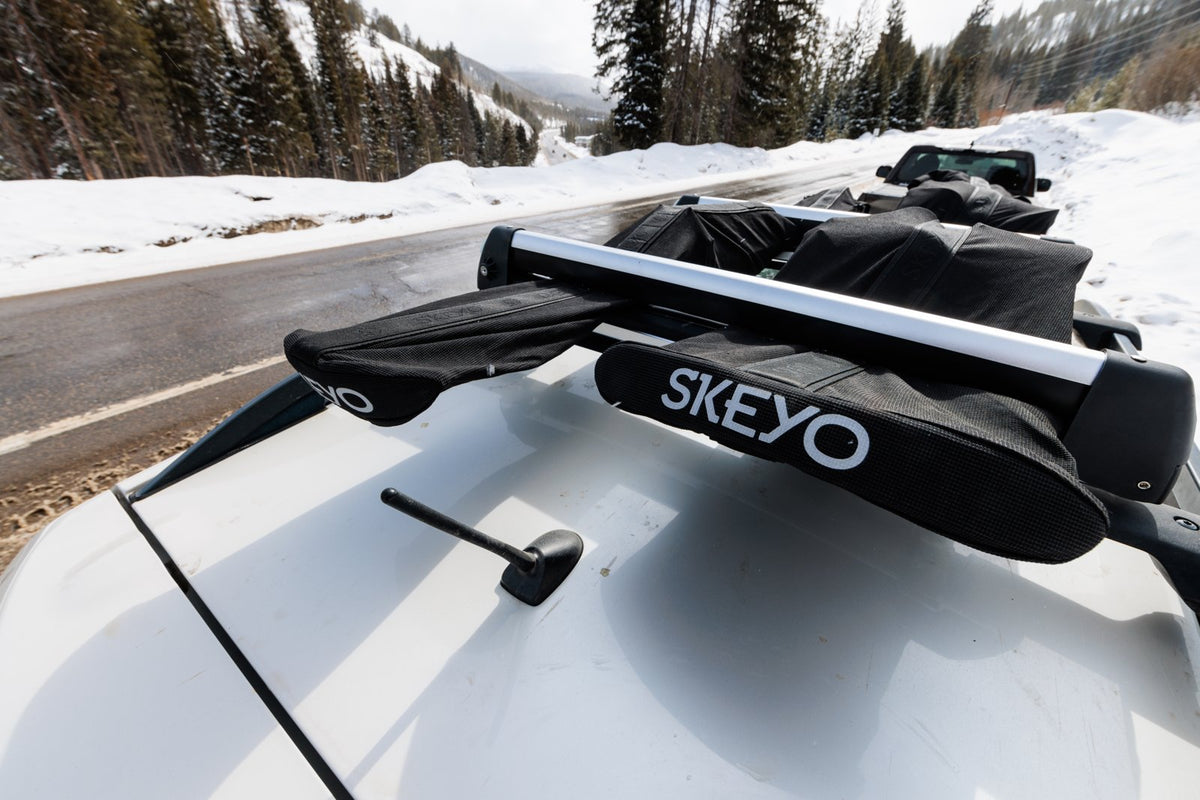
Two Skeyo bags inside the roof box, edges covered, before the lid closes.
The Skeyo way to drive
Skeyo Ski Bag
Fits 1 set of skis, with bindings on, up to 190cm. Built to protect your skis from salt, gravel, and grime on the road, in a roof box or on a rack.
Skeyo Snowboard Bag
Fits 1 snowboard, with bindings on, up to 175cm. Same road protection for snowboarders. Salt, gravel, and grime stay off your board on the drive.
Skeyo Gear Garage
42L for everything else. The fold-out lid is the Gear Deck, an integrated changing surface, with a wipe-clean waterproof lining and a laptop pocket. Your boots and gear stay dry and contained in the car, instead of loose and dripping in the back.
Free shipping on orders $150+ in the lower 48. 30-day returns on unused items. Lifetime warranty against manufacturing defects.
Roof box questions, answered
Are roof boxes waterproof?
No. Roof boxes are weather resistant, not waterproof. Thule states this in its own help pages: the seams around the two shell halves and the mounting hardware are not sealed, and prolonged heavy precipitation could result in water entering the carrier. That is why Thule's manuals advise packing sensitive cargo in a waterproof container inside the box when wet weather is expected.
Will my skis or snowboard fit in my roof box?
Check your equipment length against the maximum ski and snowboard length the box maker publishes for your model. That number varies a lot by model: Yakima lists 175cm to 215cm across its SkyBox NX line, and Thule lists up to 200cm for the Motion 3 XL Low. If your skis or board fit in the box, a fitted Skeyo bag fits too, because the bag is fitted and stretchy and closes close around the equipment. It adds a layer, not bulk.
Should I put my skis or snowboard in a bag inside a roof box?
Yes, for the grit, salt, and contact, not for meltwater. A cover keeps what rode in on your gear, and any water that gets into the box, off your surfaces, and keeps edges off each other and off the hard inside of the box. Wipe excess snow and water off before you bag them, bagging wet, snow-loaded gear holds meltwater against the equipment. A breathable bag, unpacked and dried at home, is the right way to run it.
Read Part 1: How road salt ruins your skis and snowboard on the drive